
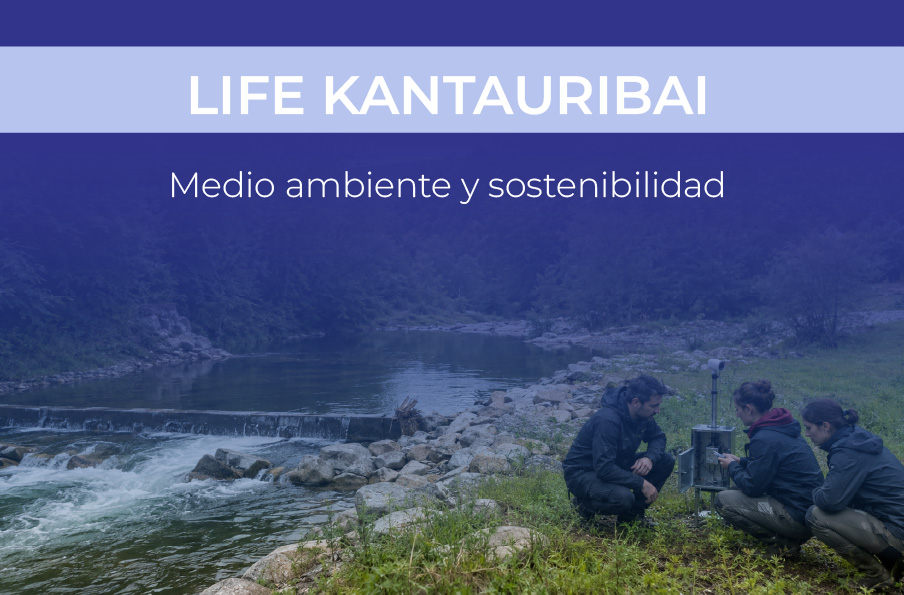
LIFE KANTAURIBAI promotes the ecological restoration of five river basins in the Bay of Biscay through initiatives focused on river connectivity, habitat restoration, and the monitoring of threatened species in Natura 2000 sites.
More Connected Rivers, More Vibrant Ecosystems
The restoration of river ecosystems is one of Europe’s major environmental challenges. Rivers are not just waterways: they are natural corridors of biodiversity, habitats, and systems that are essential to the ecological balance of the region.
It is within this context that LIFE KANTAURIBAI is being implemented—a European project aimed at the ecological improvement of the Natura 2000 river network in the Bay of Biscay, with actions in five river basins shared by Navarre, Gipuzkoa, and Aquitaine/New Aquitaine: Oria, Urumea, Bidasoa, La Nive, and La Nivelle.
With a clear goal—to improve the conservation status of riverine species and habitats through restoration, ecological connectivity, and technical monitoring—ITAGRA is participating ITAGRA, the Agricultural and Agri-Food Technology Center, one of the technology centers affiliated with NODDO, the association of technology centers in Castile and León.
Their participation reinforces the role of technology centers as entities capable of providing applied knowledge, technical expertise, and innovative solutions to high-impact environmental challenges.
The Challenge: Overcoming River Fragmentation
One of the main problems addressed by LIFE KANTAURIBAI is river fragmentation. Dams, weirs, and other transverse barriers disrupt the natural continuity of river channels, hinder the movement of migratory species, and alter the ecological dynamics of aquatic ecosystems.
In short rivers subject to high human pressure—as is the case in many watersheds that flow into the Bay of Biscay—these barriers have a particularly significant impact. They limit spawning areas, reduce connectivity between habitats, and jeopardize the recovery of sensitive species.
To address this challenge, LIFE KANTAURIBAI plans to take action on several river barriers, with 25 demolitions and 7 restoration projects to improve river permeability listed among its expected outcomes. These interventions will free up dozens of kilometers of river channels, helping the rivers regain some of their natural function.
Restore, Measure, and Learn
The value of LIFE KANTAURIBAI lies not only in taking action in the region, but also in measuring results and generating useful knowledge for future interventions.
The project combines river restoration efforts, improvements to connectivity, habitat restoration, control of invasive alien species, and monitoring of migratory species. Target species include Atlantic salmon, sea lamprey, shad, eel, the Iberian desman, European mink, and the river mussel.
The recovery of these species requires targeted interventions tailored to each environment and backed by technical data. For this reason, LIFE KANTAURIBAI incorporates automated tracking systems, cameras, sensors, and monitoring tools that provide a better understanding of how ecosystems respond to the actions taken.
This vision places innovation at the forefront: it is not just about restoration, but about restoring using data, assessing the impact, and improving long-term river management.
ITAGRA and Applied Ecohydraulics
ITAGRA’s participation in LIFE KANTAURIBAI is directly linked to its areas of expertise in applied ecohydraulics, river restoration, and technological solutions for aquatic ecosystems.
Through this line of research, the center develops scientific and technical knowledge related to water resources, fish ladders, ecological flow rates, river restoration, hydraulic simulation, and technological development applied to the natural environment.
This capability is key in projects that require a combination of engineering, biodiversity, environmental management, and technical monitoring. LIFE KANTAURIBAI embodies precisely this approach: a complex, cross-border initiative aimed at restoring the ecological functionality of rivers.
For NODDO, ITAGRA’s participation in this European project highlights the ability of the Technology Centers of Castile and León to join leading consortia and provide solutions to environmental, territorial, and sustainability challenges.
Biodiversity with a Real Impact
River restoration has effects that go far beyond simply removing infrastructure. When a river regains connectivity, species can move, reproduce, and recolonize stretches that were previously inaccessible. Habitats improve, biodiversity is strengthened, and the ecosystem becomes more resilient.
LIFE KANTAURIBAI also includes the restoration of Cantabrian alder groves, a priority habitat associated with riparian forests. In addition, it includes measures to control invasive alien species such as the American mink, the coypu, and the muskrat, which disrupt the balance of river ecosystems.
The project therefore addresses the problem on several levels: it removes barriers, improves habitats, supports threatened species, reduces external pressures, and generates technical information to guide future decisions.
Technology for Better Preservation
One of the distinguishing features of LIFE KANTAURIBAI is the use of monitoring technologies to track migratory fish. These systems provide continuous data with minimal human intervention, reducing the need for catches and improving the quality of the available data.
The deployment of cameras, identification systems, sensors, and analytical tools makes it easier to understand the behavior of species such as Atlantic salmon, identify migration patterns, and assess the actual impact of restoration efforts.
This approach aligns with a forward-thinking vision of conservation: protecting biodiversity requires taking action on the ground, but it also requires reliable information to make better decisions.
A cross-border consortium
LIFE KANTAURIBAI is also an example of cooperation among government agencies, research centers, environmental organizations, companies, and specialized agencies in Spain and France.
The project is coordinated by Orekan – Gestión Ambiental de Navarra S.A. (formerly GAN-NIK) and involves a broad cross-border consortium that includes, among other entities, the Government of Navarre / Autonomous Community of Navarre, ITAGRA / Agricultural and Agri-Food Technology Center Association, the Cantabrian River Basin Authority, the Provincial Council of Gipuzkoa, the Basque Water Agency-URA, the City Council of Donostia/San Sebastián, the City Council of Errenteria, the Hernani City Council, Agencia EFE, Iberdrola Generación, Iberdrola Renovables Energía, the Fédération des Pyrénées-Atlantiques pour la Pêche et la Protection du Milieu Aquatique, Scimabio Interface, the Communauté d’Agglomération du Pays Basque, the Conservatoire d’Espaces Naturels de Nouvelle-Aquitaine, GREGE, INRAE, and CPIE Seignanx et Adour.
This collaborative aspect is essential for taking action in shared watersheds and ecosystems that transcend administrative boundaries. River restoration requires coordination, technical expertise, and a shared long-term vision.
Environmental Innovation from Technology Centers
ITAGRA’s participation in LIFE KANTAURIBAI reflects the strategic role of the Technology Centers of Castile and León in high-impact European projects. Its contribution is part of a model of applied innovation that connects science, technology, the region, and sustainability.
NODDO, as an association of Technology Centers in Castile and León, actively promotes this very capacity for cooperation and technology transfer. Projects such as LIFE KANTAURIBAI demonstrate how the Centers’ specialized knowledge can help address real-world challenges: restoring ecosystems, enhancing biodiversity, advancing sustainability, and developing solutions with a measurable environmental impact.
Innovation also takes place in rivers. And when it is applied with rigor, collaboration, and a forward-looking vision, it can help restore them as living corridors of biodiversity.