
ARISE drives Industry 5.0 through open human-robot interaction solutions for more efficient, safer, and more competitive production environments.
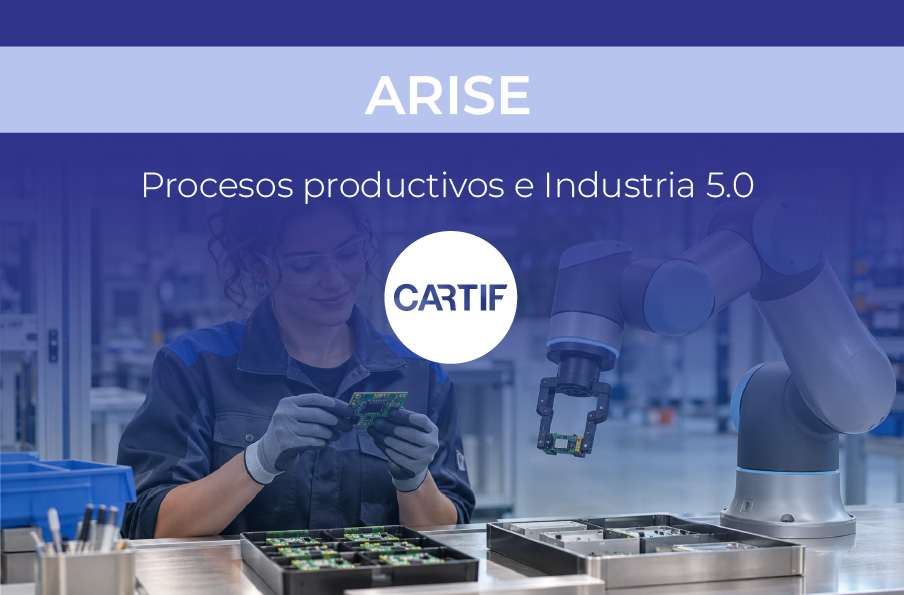
European industry faces a twofold challenge: increasing its competitiveness in an increasingly demanding global environment while, at the same time, ensuring safer, more ethical, and people-centered work environments. Automation alone is no longer enough. The real leap forward lies in achieving seamless and effective collaboration between humans and robots, combining the best of both worlds.
It is in this context that ARISE has emerged—an initiative that seeks to strengthen the Industry 5.0 model through human-robot interaction (HRI), in which CARTIF, a technology center affiliated with NODDO, is participating. The goal is clear: to develop technological solutions that enable people and robotic systems to share spaces, tasks, and decisions in a coordinated, safe, and efficient manner.
Beyond automation: true collaboration
For years, industrial robotics has focused on automating repetitive or high-risk tasks. However, new production environments demand flexibility, customization, and the ability to adapt quickly to changes in demand. This is where human-robot collaboration becomes a strategic element.
ARISE is developing digital tools to facilitate this interaction, particularly in complex production processes such as assembly, picking, quality control, and material handling. The key is not to replace workers, but to enhance their capabilities through the support of intelligent robotic systems.
The project is committed to an approach based on open technologies and interoperable standards, which will allow the solutions developed to be integrated into various industrial environments without relying on closed platforms. This is particularly relevant for small and medium-sized enterprises and companies seeking to digitize their processes without taking on significant technological risks.
Open middleware composed of standards
One of the cornerstones of the project is the creation of open-source middleware for industrial robotics applications. This middleware will act as an intermediary layer to facilitate communication between humans and robots, promoting a “common language” that enables more natural, efficient, and safe interaction.
This approach aligns with initiatives such as Vulcanexus, FIWARE, and ROS4HRI, as well as with efforts to promote interoperability within the Industry 5.0 framework. Standardization and the use of open architectures not only reduce integration costs but also accelerate technology adoption and foster the creation of a more dynamic and innovative industrial ecosystem.
In addition, ARISE plans to validate its developments in real-world experimental environments, using pilot facilities and test centers where the solutions can be evaluated under actual industrial conditions. This will demonstrate their technical feasibility and their impact on productivity, ergonomics, and operational efficiency.
Impact on Productivity, Safety, and Sustainability
Efficient collaboration between humans and robots not only improves process execution times and quality; it also has a direct impact on workplace safety and the sustainability of work environments.
By redistributing tasks based on each agent’s capabilities—precision and repeatability in the case of the robot; adaptability, judgment, and decision-making in the case of the person—available resources are optimized, and errors, accidents, and physical overexertion are reduced.
From a business perspective, this translates into greater resilience in the face of market changes, reduced operating costs, and improved competitiveness. From a social perspective, it reinforces an industrial model in which technology serves people, rather than the other way around.
A European project to strengthen Industry 5.0
The initiative brings together various technology partners and research centers with the goal of accelerating the development and adoption of collaborative solutions in the industrial sector.
In this context, CARTIF plays a key role in the coordination and technological development of the project, contributing its expertise in industrial digitization, collaborative robotics, and systems interoperability. Its track record in initiatives related to FIWARE, the iHubs network—including our iHub CARTIFactory —and the design of open architectures reinforces the project’s focus on common standards and connected digital ecosystems.
CARTIF’s participation helps transfer scientific and technological knowledge to the business community, ensuring that the solutions developed in ARISE effectively reach the industry.
Building the Future of Agile Human-Robot Interaction
The future of industry lies not only in more automated factories, but also in production environments where technology and people work together in a coordinated, ethical, and efficient manner. Human-robot interaction will be one of the pillars of this transformation.
ARISE represents a decisive step in this direction, laying the technical and organizational groundwork for safe and standardized collaboration between humans and robots. If Europe wants to lead the new industrial revolution, projects like this one are essential for establishing a competitive, innovative, and people-centered production model.
Industry 5.0 is no longer a long-term vision; it is a reality in the making. And collaboration between humans and robots will be one of its main drivers.
At NODDO Tecnológicos, we take an integrated, interdisciplinary approach, covering all technical disciplines and finding innovative solutions at every stage of the process.
If you want to grow your business and find innovative technological solutions for your processes, contact NODDO.
Follow us on LinkedIn and subscribe to our newsletter to learn about the projects, capabilities, and solutions offered by the Technology Centers of Castile and León affiliated with NODDO.