
A European project coordinated by ITCL that uses advanced technologies to detect risky situations before they compromise driving safety
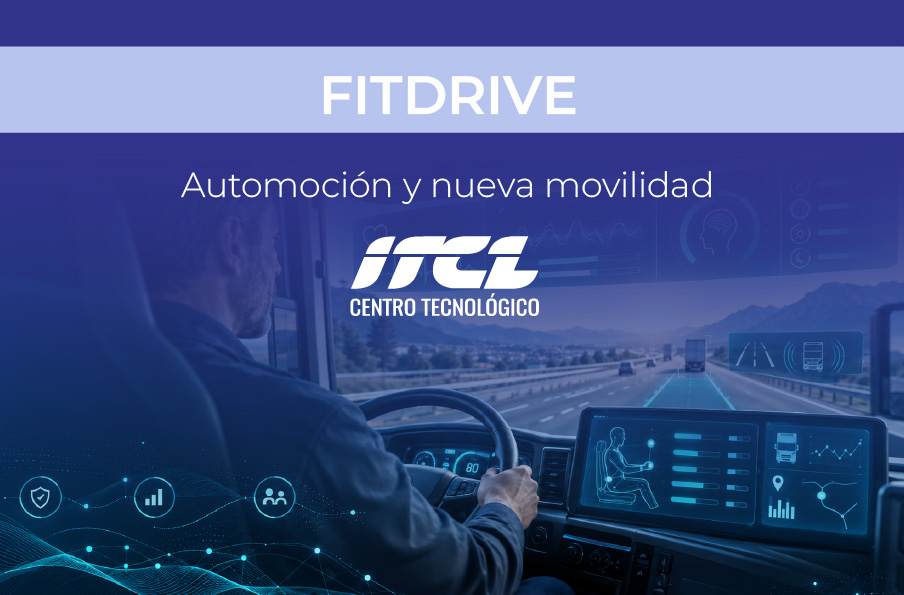
Fatigue, stress, or certain physical and mental conditions can directly affect a driver’s ability to react. In commercial transportation, where long hours behind the wheel and demanding work conditions add to the challenges of daily operations, anticipating these situations can make a decisive difference in terms of safety.
With this challenge as a starting point, ITCL Technology Center, a partner of NODDO, coordinated FITDRIVE, a European project aimed at developing and validating new tools capable of monitoring drivers’ condition and detecting potential risk situations early on.
Artificial intelligence, physiological monitoring, IoT devices, simulation, and data analysis come together in an initiative that demonstrates how technological research can be translated into concrete solutions to move toward safer mobility.
Detect changes in the driver before they become a risk
Driving is a complex activity that requires attention, quick reflexes, and adequate physical and mental fitness. Factors such as fatigue, cognitive overload, alcohol, certain medications, or the use of other substances can temporarily impair these abilities.
FITDRIVE addressed this problem by developing and validating a tool designed to monitor and evaluate driving performance, cognitive load, physical fatigue, and reaction time.
The system combines data from IoT devices, sensors, onboard intelligence, and smart tachographs with neurophysiological models and artificial intelligence techniques.
Based on this data, the models developed make it possible to detect the onset of abnormal physical states and link different types of behavior to their possible causes, such as fatigue, alcohol, certain medications, or drug use.
The project aimed to help reduce traffic accidents by 6% through the early identification of drivers affected by physical or mental decline, moving toward a prevention model based on anticipation.
ITCL leads FITDRIVE and brings the technology to real-world driving scenarios
ITCL played a particularly significant role as coordinator of the European FITDRIVE project, leading an international consortium made up of organizations specializing in various technological and scientific fields.
In addition to coordinating the project, the Technology Center participated in the development of the truck simulator and in the creation of specific scenarios designed to study situations that can cause a decline in driving abilities.
ITCL also played a role in the tests conducted in Spain, including tests in controlled environments and subsequent validation phases. These tests combined simulation and actual driving to gather information on the behavior of professional drivers under various conditions.
During the trials, parameters related to, among other things, brain activity, workload, stress, fatigue, and rest were monitored using sensors, wearable devices, and other data-collection technologies.
This combination of simulation, monitoring, experimentation, and testing under conditions that closely resemble real-world driving allows for the application of technological research to scenarios directly related to the needs of commercial transportation.
Artificial Intelligence for Detecting Anomalous Behavior
One of the key features that sets FITDRIVE apart is its use of artificial intelligence to analyze data collected during work and while driving.
The system uses neurophysiological models and data from IoT devices, onboard intelligence, and smart tachographs to identify anomalous behavior and link it to its most likely cause.
Thus, the technology is not limited to recording isolated parameters; rather, it allows for the joint analysis of various indicators related to the driver’s physical condition and behavior.
This approach opens up new possibilities for developing systems capable of early detection of situations involving impaired driving ability and enabling preventive action before such situations lead to accidents on the road.
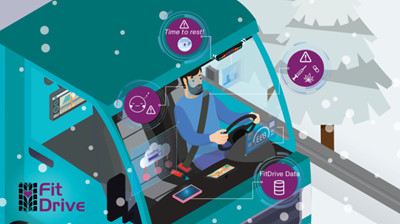
Advanced technology applied to real-world driving conditions
FITDRIVE integrated various technological lines into a single monitoring and evaluation system:
- Monitoring of neurophysiological and biometric parameters related to the driver’s condition.
- Application of artificial intelligence for the detection of anomalous behavior.
- Use of sensors, IoT devices, onboard intelligence, and smart tachographs.
- Development of simulators and specific scenarios to study situations that can affect driving.
- Tests with professional drivers in simulators, on test tracks, and under real-world driving conditions.
- Integration and analysis of information to facilitate the assessment of the driver’s condition.
- Development of screening methods to detect substances that may negatively affect driving ability and reduce the time required to perform the tests.
The project included testing with professional drivers in Spain and other European countries, allowing the technology to be evaluated in different scenarios and facilitating the transition from research to its application in real-world situations.
A technology with the potential to transform road safety
The developments addressed in FITDRIVE demonstrate the potential for integrating monitoring, artificial intelligence, and data analysis into future road safety systems.
These capabilities are particularly relevant to areas such as freight and passenger transportation, fleet management, intelligent transportation systems, road safety, and advanced driver monitoring technologies.
The value of this technology lies particularly in its preventive approach. It is not just a matter of recording what happens while driving, but of having tools capable of detecting indicators that allow drivers to take action before fatigue or impaired abilities lead to an incident.
In addition, FITDRIVE provides for the sharing of relevant information through cloud-based systems, enabling the data generated to help improve decision-making and enhance road safety.
FITDRIVE showcases ITCL’s technological capabilities as they are applied to safer mobility
FITDRIVE is an example of how the capabilities of technology centers can turn complex challenges into developments applicable to strategic sectors.
Through its coordination of the European project, the development of simulation environments, and participation in testing and validation, ITCL has helped advance new ways to assess the condition of professional drivers and strengthen road safety.
The project, funded by the European Union’s Horizon 2020 research and innovation program, brought together specialized organizations from different countries and disciplines to address road safety through artificial intelligence, neurophysiology, the Internet of Things (IoT), simulation, and intelligent transportation systems.
An initiative that also highlights the potential of the existing technological capabilities in Castile and León to coordinate and participate in European research projects that have a direct impact on businesses, professionals, and society.

We connect companies and challenges with the capabilities of technology centers
At NODDO, an association comprising eight technology centers in Castile and León, we connect the capabilities and expertise of our member centers with the needs of businesses and organizations to facilitate the development of innovative solutions.
Projects such as FITDRIVE demonstrate the specialized expertise available at technology centers and their ability to transform research and technology into solutions that address real-world challenges.
If your company or organization works in mobility, transportation, artificial intelligence, monitoring systems, or security and wants to explore new technological solutions, contact NODDO, and we’ll help you match your challenge with the most suitable capabilities.
Follow us on LinkedIn and subscribe to our newsletter to learn about new projects, capabilities, and solutions from the technology centers affiliated with NODDO.