
High- and medium-high-tech companies have reached a record 394.9 million euros in R&D spending, while the Technology Centers of Castile and León are strengthening their activities, employment, and ties to the business community.

Castile and León continues to strengthen its scientific and technological capacity. The latest available data show, on the one hand, a record high in research and development spending by high- and medium-to-high-tech companies and, on the other hand, significant growth in the activity of the region’s technology centers.
Two different but complementary indicators that reflect the evolution of an ecosystem in which companies, technology centers, universities, and public administrations play a fundamental role in transforming knowledge and technology into innovation, competitiveness, and new economic opportunities.
Record Business Investment in R&D
In 2024, high- and medium-high-tech companies in Castile and León allocated a total of 394.9 million euros to R&D activities, a 24.5% increase from the previous year and the highest figure in the data series analyzed between 2021 and 2024.
Their role within the regional innovation system is particularly significant. Although they account for only 1.65% of all companies in Castile and León, they account for 64.4% of all business R&D spending and 60.6% of the workforce engaged in these activities in the business sector.
Specialized employment is also on the rise. In 2024, these activities accounted for more than 3,200 full-time equivalent jobs in R&D, a 20.6% increase from 2023.
In addition, combined revenue exceeded 20.6 billion euros, up 14.1% from the previous fiscal year and 62.2% higher than the levels recorded in 2020.
The manufacturing of motor vehicles and electrical equipment continues to play a significant role, alongside sectors such as software development and IT consulting, the chemical and pharmaceutical industries, machinery manufacturing, telecommunications, and research and development.
This diversity helps to build a technological foundation capable of generating economic activity, skilled jobs, and new opportunities for growth.
Technology Centers Strengthen Their Ties with Businesses
Along with this trend in business investment, the latest data from the Economic and Social Council’s (CES) Report on the Economic and Social Situation of Castile and León in 2025 also show a strengthening of activity at the region’s technology centers analyzed in the report.
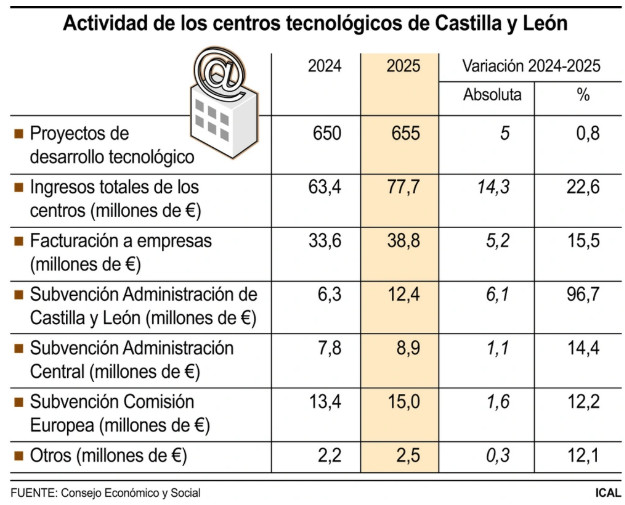
In 2025, they posted revenue of 77.7 million euros, compared with the 63.3 million recorded the previous year, representing a 22.6% increase .
Particularly relevant for assessing its connection to the business sector is the trend in revenue from business-to-business sales, which reached 38.8 million euros—a 15.5% increase over 2024.
This growth reflects the Centers’ focus on business needs and their role as a technological support for the development of new products, processes, and innovative solutions.
Activity also remains at high levels, with 655 projects completed in 2025, compared with 650 in the previous fiscal year.
Greater technological capacity and skilled jobs
The growth of technology centers is also reflected in their human capital.
In 2025, the number reached 961 professionals, a 14.4% increase from the previous year and well above the 679 recorded in 2021.
Of these, 895 were full-time staff members, representing a 15% increase from the previous year. The number of professionals with advanced degrees also rose, reaching 563, as did the number of technical and support staff.
A highly specialized workforce that is one of the key assets for developing technology and transferring knowledge to businesses.
The data also show a growing ability to secure competitive funding at the regional, national, and European levels, thereby strengthening the Centers’ capacity to undertake technology projects of greater scope and complexity.
The challenge: to extend innovation to more companies
Castilla y León has business, scientific, and technological capabilities that continue to advance. The next challenge is to ensure that this potential reaches an ever-increasing number of companies—especially small and medium-sized enterprises—and translates into new products, processes, and services, as well as skilled jobs and greater competitiveness.
In this context, the technology centers affiliated with NODDO play an essential role: they make knowledge, infrastructure, specialized equipment, and multidisciplinary teams available to meet the innovation needs of the business community.
At NODDO, we promote cooperation among our member technology centers, linking their technological capabilities to the challenges faced by companies and fostering collaborative projects, technology transfer, and R&D&I solutions tailored to each specific need.
Innovation depends not only on generating knowledge, but also on having the necessary mechanisms to bring it to market.
Strengthening the connections between businesses, technology centers, universities, and public administrations is, in fact, one of the major challenges facing the regional innovation ecosystem and one of the objectives of Castilla y León’s RIS3: to ensure that the region’s scientific and technological capabilities translate into business innovation, productivity, skilled jobs, and new economic opportunities.
A scenario in which cooperation and technology transfer will be key to consolidating Castilla y León’s track record of innovation.
Sources: Regional Government of Castile and León, based on the Statistics on R&D Activities and the Structural Business Statistics from the National Institute of Statistics (INE), and the Report on the Economic and Social Situation of Castile and León in 2025 from the Economic and Social Council of Castile and León (CES).