
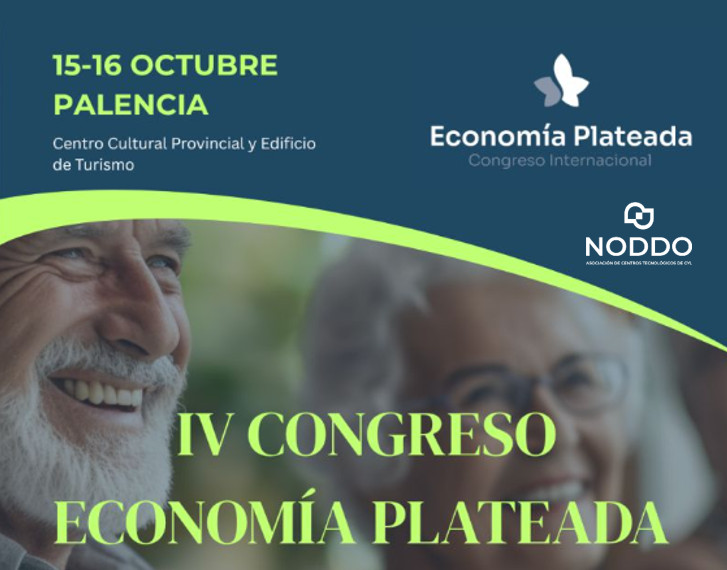
NODDO, the association of Technology Centers of Castile and León, will collaborate with the 4th International Congress on the Silver Economy, to be held on October 15 and 16, 2026, by supporting the participation and visibility of its member Technology Centers. ITCL and CARTIF will be present at this event, which addresses challenges closely related to their expertise in health, digitalization, technology, and quality of life, and which is particularly aligned with the Health Flagship Initiative of Castilla y León’s RIS3.
Innovation and Technology in the Face of an Aging Society
Longevity poses new challenges in areas such as health, care, personal autonomy, housing, mobility, digital inclusion, and the development of new products and services. At the same time, it opens up opportunities to apply knowledge and technology to improve people’s quality of life and to foster the economic and social development of regions.
This will be one of the focal points of the 4th International Congress on the Silver Economy, which will bring together public administrations, businesses, universities, knowledge and technology centers, social organizations, researchers, and professionals on October 15 and 16.
NODDO will collaborate with the Congress by supporting its outreach and helping to highlight the capabilities of the associated technology centers in Castile and León, which play an essential role in transforming knowledge and research into solutions that address the challenges faced by businesses, government agencies, and society.
ITCL and CARTIF, technology centers affiliated with NODDO, will be participating in this edition, bringing to the event expertise and technological knowledge related to fields that play a prominent role in the Silver Economy.
AGENDA https://www.economiaplateada.org/programa-4o-edicion/
Technology Centers as Part of the Response to New Health and Care Challenges
Technology is playing an increasingly important role in adapting to an aging population. Digital solutions, artificial intelligence, new models of care, technologies designed to promote personal autonomy, and tools to improve social and health care services are among the areas where applied research and technology transfer can provide solutions.
It is precisely at this point that the role of the Technology Centersbecomes particularly significant, given their ability to bridge the gap between research, technology, and real-world application by working in partnership with companies, government agencies, and other stakeholders in the innovation ecosystem.
For NODDO, this presence is seen as an opportunity to highlight the existing technological capabilities in Castile and León, facilitate new connections, and share the Centers’ expertise with organizations working on challenges related to longevity.
A direct link to the RIS3’s Flagship Health Initiative
The topics to be addressed at the conference are also clearly linked to the Health Flagship Initiative of the Research and Innovation Strategy for Smart Specialization (RIS3) of Castile and León, as well as those of ITCL and CARTIF.
The initiative is linked to the priority “Castilla y León, a region with a high quality of life” and is part of a health and social-healthcare ecosystem comprising companies, government agencies, researchers, and scientific and technical infrastructure. Its objectives include strengthening this ecosystem, generating new scientific and technological knowledge, and fostering new business and economic development opportunities.
Within this framework, three major health challenges have been identified, which are closely related to some of the issues that will be addressed at the conference.
The first focuses on digital transformation to create more efficient social and health care services, promoting the development and adoption of innovative digital technologies in these services.
The second aims to accelerate the development and market launch of advanced therapies and medical devices through collaboration and innovation, strengthening the transition from research to application.
The third challenge is particularly closely linked to the theme of the Silver Economy; it focuses on new care models and technological solutions for active aging. Its goal is to implement new solutions and create opportunities within a leading ecosystem for active and healthy aging.
RIS3 also aims to advance the testing of innovative technological solutions applied to the care sector and to promote collaborative projects among research centers, companies, and third-sector organizations, in both urban and rural areas.
Silver Economy, Knowledge, and Collaboration
The Congress approaches the Silver Economy from a cross-cutting perspective, addressing issues such as healthy aging; care and autonomy; age-friendly environments and housing; mobility and accessibility; participation and learning; digitalization and artificial intelligence; and new consumption models associated with a longer-living society.
The event also includes a 2026 Call for Posters, open to universities, research and technology centers, government agencies, companies, startups, associations, social organizations, professionals, and other stakeholders who wish to share research, projects, experiences, solutions, and best practices.
The selected works will be exhibited during the two days of the conference and will subsequently be included in its Digital Gallery.
The participation of NODDO alongside ITCL and CARTIF will thus strengthen the presence of the Technology Centers of Castile and León in a forum dedicated to sharing knowledge and fostering collaboration around one of the major social and economic challenges of the coming years.
At NODDO, we continue to work to align the capabilities of our partner technology centers with the challenges faced by businesses, government agencies, and society, fostering cooperation and technology transfer to transform these challenges into new opportunities for innovation.