
The fact sheets on the capabilities of the Technology Centers link business and regional challenges to areas of specialization, testing infrastructure, and opportunities for collaboration in industry, sustainability, and quality of life.
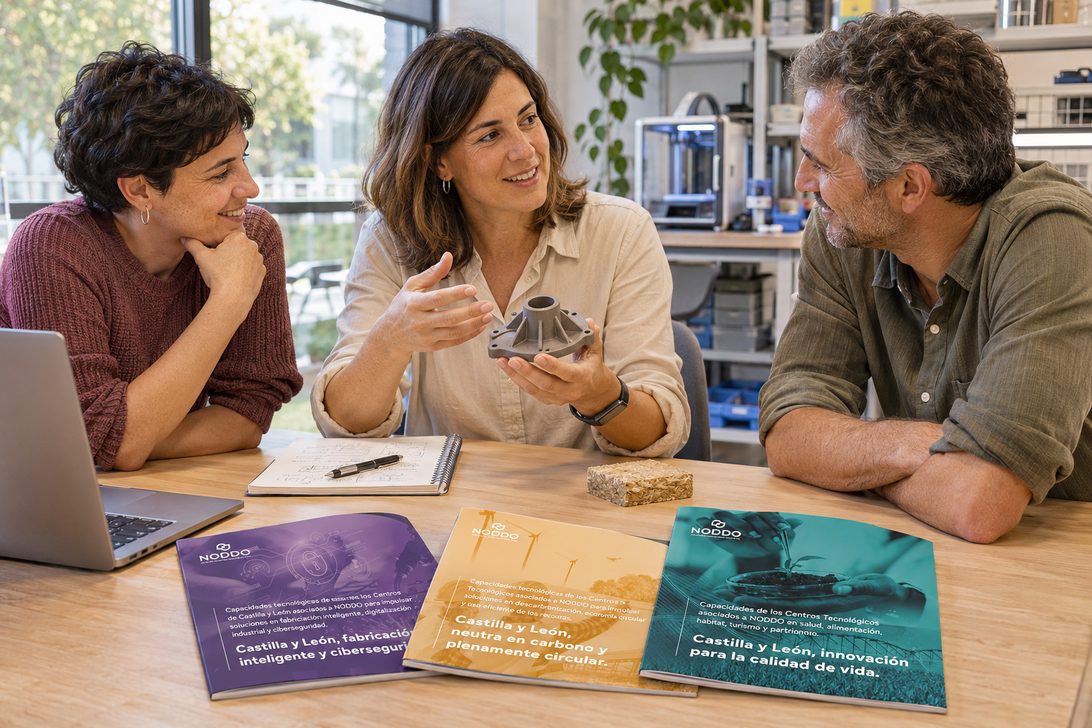
The documents link business and regional challenges to specialization, testing infrastructure, and opportunities for collaboration in industry, sustainability, and quality of life.
A company that wants to innovate needs to identify what knowledge can help it, where to test a proposal, and how to verify that a solution meets its needs. The Castile and León Technology Centers affiliated with NODDO provide the capabilities to support this process. To help companies and organizations learn about these capabilities and connect with them, NODDO has compiled this information into three fact sheets available on its website.
The documents provide an overview of three areas: smart manufacturing and cybersecurity; carbon neutrality and the circular economy; and innovation for quality of life. Each document outlines challenges, technological capabilities, and centers, offering initial guidance on opportunities for collaboration.
The value of this compilation lies in demonstrating what technology can offer in response to a specific need. Improving a manufacturing process, exploring ways to utilize a byproduct, or developing a food product tailored to new consumer profiles requires different skill sets. These case studies provide insight into these specialties and help identify where they can complement one another.
In smart manufacturing and cybersecurity encompasses capabilities in automation, robotics, machine vision, predictive maintenance, digital twins, and industrial system protection. This field also includes traceability and the digitization of the primary sector, connecting processes with the information needed to understand and improve them.
The dossier dedicated to a carbon-neutral and fully circular Castilla y León covers the bioeconomy, resource recovery, renewables, energy storage, and energy management. It is rounded out by eco-design, life-cycle analysis, and environmental footprint measurement, to explore production and utilization alternatives on a technical basis.
The document on innovation for quality of life brings together capabilities related to food, health and care, housing, and heritage. It presents opportunities for work in the development and validation of food products, telecare, support for personal autonomy, and technologies for managing and enjoying urban and rural environments.
Behind these lines of work are specialized teams, laboratories, pilot plants, and testing and validation environments. Their contributions make it possible to analyze a need, develop alternatives, and test their performance before moving forward with their implementation. Each center contributes based on its area of expertise; collaboration allows us to combine capabilities when the project requires it.
This initiative is supported by the Regional Government of Castile and León through ICECYL, the Institute for Business Competitiveness of Castile and León.
At NODDO, we facilitate the connection between these capabilities and organizations seeking a technological solution. The fact sheets are a tool for initiating that conversation and exploring collaborations tailored to each challenge. Check out the three fact sheets on our website. If your company or organization would like to discuss a specific need, you can email us at contacto@noddo.es.