
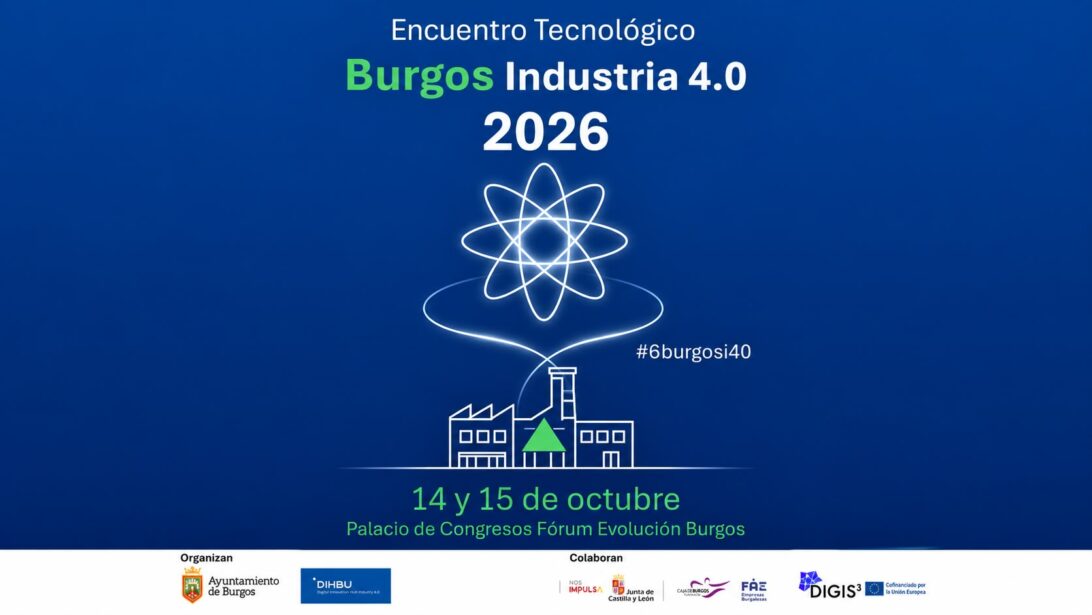
Industrial innovation developed in Castile and León will feature prominently at the Burgos Industry 4.0 2026 Technology Conference #6burgosi40, to be held on October 14 and 15 at the Fórum Evolución Burgos.
NODDO will participate in this sixth edition alongside several of its partner Technology Centers at the Burgos Industry 4.0 Technology Conference, offering companies solutions that allow them to see firsthand how technologies such as artificial intelligence, machine vision, robotics, data spaces, and mixed reality can address specific challenges in the industry.
The event has established itself as a leading gathering focused on industrial digitization, and this year it will bring together more than fifty organizations at Expo Industria 4.0, featuring technology demonstrations, use cases, technical conferences, business meetings, and spaces for collaboration between industry and technology. The organizers also anticipate more than 20 real-world case studies as part of the Industrial Track 4.0 Technical Sessions.
NODDO’s participation is specifically aimed at bringing technologies developed by the Technology Centers closer to the business community and demonstrating how cooperation and knowledge transfer make it possible to address industrial needs from very different fields.
CTME and Cesefor will share booth 26 at NODDO
One of NODDO’s main highlights during #6burgosi40 will be Booth 26 at the Industry 4.0 Expo, where CTME | Miranda de Ebro Technology Center Foundation and the Cesefor Foundation will present two proposals that reflect the practical and complementary nature of the capabilities of the associated Technology Centers.
On the one hand, CTME will present solutions related to advanced industrial data analytics, data spaces, and the Digital Product Passport, integrating technologies such as edge computing, interoperability, artificial intelligence, and advanced data processing.
Its proposal includes tools such as MFiot, DataForge, JSON-LD Studio, and PASSPORT, which enable companies to address different phases of the industrial data lifecycle—from capture and processing to standardization, exchange, and utilization. The goal is to help companies transform scattered data into useful information to improve traceability, automate processes, and support decision-making.
The system integrates technologies such as industrial Data Fabric, edge computing, artificial intelligence, ontologies, EDC connectors, graph databases, and the Digital Product Passport within a modular and interoperable ecosystem. The CTME demonstrator is officially featured at Booth 26 at the Industry 4.0 Expo.
OAKPRINT Brings Artificial Intelligence to the Wood Industry
In the same space, Cesefor will present OAKPRINT, a computer vision and artificial intelligence application designed to sort staves for the manufacture of oak barrels.
The solution analyzes the anatomical characteristics of each stave, such as grain and density, and predicts its oxygen transmission rate (OTR). Based on this information, it is possible to classify the wood into homogeneous groups before the barrel is assembled and to make OTR an objective parameter for coopers and winemakers.
This technology paves the way for more predictable and reproducible manufacturing and processing methods and serves as an example of how advanced digital tools can be applied to value chains linked to the forestry and agri-food sectors.
The industrial prototype is installed at the INTONA cooperage and has already been used to produce an initial batch of 48 barrels classified according to their OTR, which are currently being used in oenological validation tests at the Ramón Bilbao winery. The organizers of #6burgosi40 have also included OAKPRINT among the demonstrators at booth 26.
ITCL will showcase computer vision, mixed reality, and autonomous robotics
The participation of the technology centers affiliated with NODDO will extend to other areas of the Industry 4.0 Expo.
ITCL Technology Center will feature three demonstration stations showcasing industrial applications of computer vision, mixed reality, and robotics.
The first will focus on high-precision visual inspection for the detection of anomalies and defects. The technology allows parts to be compared with correct reference models and detects manufacturing, material, or assembly defects using only a small number of images of parts deemed valid.
A second demonstrator will allow users to experiment with an editor and validator for industrial layouts in mixed reality. Using specialized glasses, companies can virtually configure and analyze machinery, workstations, walkways, or operational areas within their actual physical space before making any real changes on the factory floor. This allows them to anticipate interference, study traffic patterns, and compare different configurations without halting production.
ITCL will also present a system for autonomous thermographic inspection system using a quadruped robot, equipped with thermal cameras and on-board processing. The robot can move autonomously through industrial environments, detect thermal anomalies, and transmit the information for tasks such as predictive maintenance and the monitoring of electrical panels, pipes, motors, or industrial facilities.
CARTIF will present a real-world example of artificial intelligence applied to industry
The presentation of capabilities by the partner centers will be complemented at the Industrial Track 4.0 Technical Conference by the participation of the CARTIF Foundation.
Daniel Gómez Martín, director of CARTIF’s Industry 4.0 Division, will present the case study “AI in the Real World: A Use Case for Asphalt Production” on October 14 .
This case study demonstrates the application of various artificial intelligence solutions within a single industrial value chain, from the production plant to the laying of asphalt. Among its applications are anomaly detection, quality control and traceability, mix design, and analysis of paving conditions.
According to the official schedule, this presentation is set for October 14 at 6:20 p.m. as part of the session on artificial intelligence use cases in industry, and it notes that the work was carried out by CARTIF in collaboration with EIFFAGE as part of the European s-X-AIPI project.
Technology Applied to Industry Challenges
Industry 5.0, artificial intelligence, industrial cybersecurity, and quantum computing applications are among the main thematic areas of this sixth edition of #6burgosi40.
The presence of NODDO and its partner technology centers will showcase the various levels and areas of application for these technologies, ranging from intelligent industrial data management and product traceability to predictive maintenance, automated inspection, plant planning, and the application of artificial intelligence to production processes.
For NODDO, these types of events also provide an opportunity to align the centers’ technological capabilities with specific business needs, foster new collaborations, and facilitate the transfer of solutions that have been developed and validated in real-world settings.
A meeting place for industry, technology, and innovation
The Burgos Industry 4.0 2026 Technology Summit is organized by DIHBU and the City of Burgos, with support from the DIGIS3 ecosystem and the participation of collaborating entities such as FAE Empresas Burgalesas, Fundación Caja de Burgos, and the Regional Government of Castile and León. Official information about the event confirms that it will take place on October 14 and 15 at Fórum Evolución Burgos.
The program includes the Industry 4.0 Expo, the Industry 4.0 Technical Conference, the Industry 4.0 Matchmaking Event, and the Industry 4.0 Investment Forum, providing a space to see technology in action, discover real-world applications, and forge new business and technology connections.
Attendance at the events is free, but registration is required. https://fienta.com/es/encuentro-tecnologico-burgos-industria-4-0-2026